Search This Blog

Blog Archive

Showing posts with label limited storage space. Show all posts

Saturday, January 7, 2017

Storage of Unwieldy Things Onboard


Preparing to install new battery bank below aft berth
As ever, I am on the lookout for ways to maximize our finite space aboard Northern Star and to make that available space easier to access. Over the past year and a half I have caught myself staring at the interior hull of the aft cabin, as if in a trance.  I was fixated on one long expanse of wood paneled wall curving out and up along the hull. Below that wall, on the aft cabin berth lay stacks of bulky and frequently quite long items that have to be stored somewhere on the boat.  

All manner of awkwardly shaped things are in there—the stiff unwieldy rain panel (we lost one in a wind storm) that zips onto the dodger, the helm station canvas, a really long fishing rod and reel, an 8’ long spear for lobster fishing, a long-handled boat brush, clothes washing “plunger,” shade tarp, a beach pop-up tent, wind scoops, covers for the Garmin instruments, a Loos* gauge, a “pigstick”**—all this extraneous stuff!  Stuff that doesn’t really belong anywhere in particular.  Stuff that wouldn’t have to be taking up space on a berth where a guest otherwise could sleep. But what to do with it? And all the while, there above the berth, staring at me, is that long bare wall……
Hanging sling mounted on the aft cabin wall.  A mesh hammock hangs beyond.

Somewhere or other, I must have seen a picture of the concept that popped into my head—a suspended sling.  I cannot take credit for designing it, but perhaps a little credit for adding to the idea with an embellishment or two.  The concept is a style of storage that probably has its’ origins in the use of an apron to hold a bunch of apples or in the the use of a hammock to hold anything that must be kept up off the floor.  A sling is a very simple concept.
Opening one of the PermaLock fasteners

After measuring that bare aft cabin hull wall, I set out to make a wall-mounted sling that would be able to contain the above mentioned items and would not use up the entire wall either.  I decided to make a sling that would measure  42” X 54”.  Because I acquired some large scraps of Sunbrella and Pfiftertex when I was last in Annapolis, I had a lot of the necessary supplies on hand.  What I did not have were the kind of fasteners that would attach the sling to the wood paneling of the hull—fasteners that can be twisted to open one side of the roll as it hangs. SailRite had the answer for that; Permalock Fasteners that are designed to attach cloth to a hard surface.  I had them delivered to us in Florida, when I knew we would be in one spot for a week or so.  These are nifty little pieces of hardware.  
PermaLock fastener

One side of the sling (42” side) is permanently mounted on the wall using the Permalock Fasteners. The 54" sling then falls to the bed below and the opposite end of the sling is then lifted up and reattached to the wall using those same fasteners, making a 27 inch-deep sling.  To make the most of the storage space with this sling, I added some external attachments to hold the very long items such as the fishing rod, the spear, boat brush, clothes washing plunger, etc. on the outside of the sling.  My intention was that I would then be able to access those individual, long items without having to open up the entire sling. 

This has turned out to be a very usable space for us.  The sling takes away very little space from the aft cabin since the wall space was “unused” space anyhow.  Because the sling follows the curve of the hull, it hangs above but also away from the surface of the bed so a person can sleep below.  If my guest is claustrophobic, he or she may not like sleeping with these items stored in such close proximity, however, I suspect that someone who is claustrophobic is not going to want to sleep in the aft cabin anyhow.  
Rings, snaps, loops can be attached on the outside

The materials that I used for this sling were:

  • A Pfifertex panel cut to 42” X 54.”  I allowed 1” for folded hems on the two long sides.  
  • Sunbrella strips (4) cut 43" long and 3" wide to encase each short side of the sling.  I added an additional layer of sturdy canvas as stiffener between the two pieces of casing.  These encased shorter ends must be very rugged as they will be attached to the wall.  
  • 9-10 yards of 1” nylon webbing.  Because I knew this sling would be expected to hold a significant amount of weight, I used nylon webbing to stitch 4 lengths (54”) to match up with the fasteners.  I also used 3-4 yards to sew 4 extra lengths of webbing that lie on the outside of the sling. These are adjusted by 4 side-release buckles to accommodate blankets and things with a circumference of up to 24".
  • 4 plastic (1") side-release buckles.  More could have been attached with the nylon webbing if desired.
  • 4 Permalock Fasteners.  If the sling were any wider, I’d have wanted to use more Permalock Fasteners. 

  • Scraps of clear vinyl (20 gauge) — I used 4 squares of it to make “windows” so that I can see what’s rolled up inside of the sling without taking it down.
  • 4 plastic rings, attached across the length of the pack.  Long lightweight items can be attached at those as needed.


Here’s to making the most of boat space…Cheers and Happy New Year.
The sling and aft cabin are loaded with supplies for the Bahamas
*Loos gauge - a tool designed to measure the tension of cables/rigging. 
**pigstick - a homemade stick that can be pulled up the mast to extend above the height of the mast. If the pigstick makes contact with the underside of a bridge, the boat is not going under.  

Sunday, November 27, 2016

Shoes, Shoes, SHOES!


Northern Star living area, stateroom beyond

I like shoes.  I really don’t have occasion to wear all the various styles of shoes that I wore while living on land, but I still like to have a few pair with me onboard. Some people might tell you that I have too many shoes onboard, but that is a discussion for another time, maybe. (Or maybe not.)   
Keens--my most comfortable shoes

It is entirely justifiable, in my opinion, to have shoes onboard for the following purposes:  sturdy hiking shoes for cooler days on land or water (Keens--check); 

Chacos--great arch support and perfect for hiking or water.
walking sandals with great arch support that can be worn in the water (Chacos--check); slip-on loafer boat shoes when neither of the above pair is appropriate (Sperry--check);
Note my foot wearing a slip-on loafer boat shoe
sneakers for exercising (Balance, check); comfy all-vinyl shoes to wear to the shower or when washing down the boat or Jax (Crocs--check); and little black sandals to wear with a sundress (also Crocs--check).  And, I have a pair that I would wear if I were to make an unplanned trip to see family in the winter—the shoes that could be worn on the plane with wool socks, and be appropriate in Minnesota in January (Bass--check.)  

Rain boots are necessary, not fun
Of course, we each have a pair of rain boots which are required sailboat gear so they don’t "count" as shoes.  We also each have a pair of fins, which are really beyond the scope of this discussion about shoes. (Okay, and I’ll admit that I do have another couple of pair onboard which I really can’t justify, but I didn’t know that I couldn’t justify them at the time I brought them onboard, so they have to be tucked away, too.)


We both have Crocs
The problem boils down to space.  Boats have a finite amount of space.  And shoes tend to be bulky.  I have scoured out the easily usable spaces where shoes can be tucked away.  The “winter shoes” lie on the floor of our hanging locker.  The rain boots live in our shower when we are not using it, which is frankly 99% of the time. All the other shoes need their own places to belong.  On a sailboat, every item needs its’ own home.  When the boat heels (no pun intended) things tend to move around, sometimes quite abruptly, so it’s important to be able to put things in their place.

Available walking space in stateroom
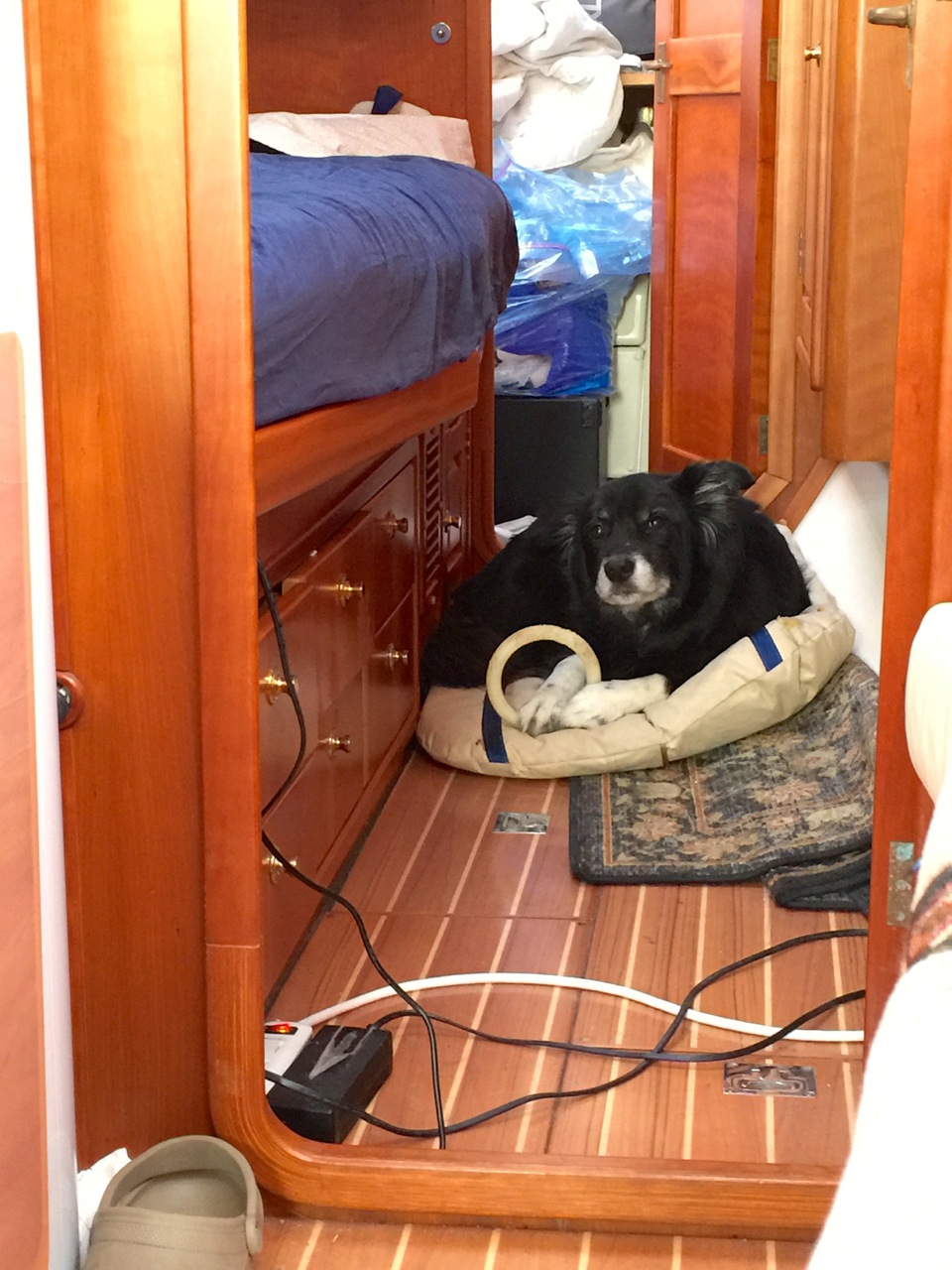
Shoes tend to end up everywhere--under the table, under the nav (navigation) station, scattered in the cockpit, kicked off beside the bed; you get the picture.   The ones that get kicked off before climbing into bed tend to cover the available walking space on the floor.  Between the shoes and Jax lying beside the bed, walking can be precarious.  Shoes need to be contained. 
Shoes got shoved against the hull

About a year into this adventure, I had an "ah HA" moment.  I found an underutilized space in our stateroom.  Underutilized because it’s sort of part floor and part wall—a space underneath a cabinet at a 45 degree angle due to the shape of the hull.  Since we can’t walk on a 45 degree angle, it’s kind of useless space.  For a long time, I’ve shoved our shoes up against that 45 degree angle which works as long as the boat is level.  Then, it dawned on me.  That would become a permanent shoe storage place, at least for several pairs of them if only I could make them stay put.  
Between the bed and cabinets there are shoes and Jax


When I measured the area (16" from floor to bottom of the cabinet) it was tall enough for my husband’s larger shoes to fit lengthwise up and down.  And wide enough (28") for five to six pair of shoes stacked alongside one another.  Great!  I just needed to make a large "pocket" that would be attached to the wall.  I would cut the fabric front and back larger than what I wanted the finished product to be.  When the pocket is filled with shoes it will of course, expand outward which will then shorten the overall length of the pocket. This may be quite obvious to everyone else, but I had to think this through to make the most use of my available space. 
Shoes stay put in this "pocket", attached to the hull below the cabinet.
I didn't want the fabric of the shoe pocket to rest on the floor where it would just collect dust and dog hair, so I left the bottom edge open enough to allow for the heels of the shoes to slide in and rest on the floor rather than the pocket itself. 

Bungee is threaded through a sleeve on the back, against the hull. 
I am a big fan of Pfifertex.  Pfifertex is a manmade fabric available through SailRite.  It is designed for outdoor uses.  I used it to make the shade panels around our cockpit. The denser weave is called 90% coverage, and the looser weave is 70%.  I had the 70% weave on hand.  This seemed like a good choice for the fabric because Pfifertex can be washed down, scrubbed, sprayed with bleach water to kill and prevent mildew and it’s really durable. 

Cockpit shade panels

The design I came up with is quite simple. Essentially, it’s a pocket with 6 grommets spaced across the front and a sleeve across the back where one continuous bungee cord threads through.  
Diagram of the "pattern"

The front and back are sewn together on the short ends, and are connected on the bottom by 4 or 5 (4") Pfifertex strips sewn to each bottom. These open up the bottom enough for the heels of the shoes to poke through to rest against the floor. Additionally, this allows for more air circulation which is helpful in high humidity. 
One continuous bungee threads all the way around

On each end of the hanging pocket, I mounted a pad eye to the boat. The bungee cord hooks to one pad eye, slides through the sleeve across the back of the pocket, through the other pad eye and then back across the front through the grommets and hooks back onto the first pad eye.  Having one continuous bungee cord makes it easy to pull it out toward myself so I can see the shoes in there, and to make it easy to shove other shoes in there. Voila’.
Six large grommets are spaced across the front of the shoe pocket.  

A woman’s gotta have her shoes.

I’ve made some other little space-conserving projects too, which I’ll write about soon.   


Friday, February 5, 2016

How is Our Galley Like Your Kitchen?

Spoiler Alert:  This is not an exciting topic--read at your own peril.
Upright edges or fiddles surround edges of counters

Twiddling my thumbs—waiting on a weather window to cross to the Bahamas in a week—maybe.  There are questions that pester some of our family and friends.  Q- “What do you do about food when you’re sailing?” (A- “We eat it, by mouth”).  Q- “How do you get groceries?”  (A- “We pay for them.”)  This topic deserves better explanations than those, so I’ve taken pictures to help explain how our galley is very much like your kitchen on land, and to allay any concerns about us eating a balanced diet aboard NORTHERN STAR
Open fridge.  Freezer is closed, on the left.

First of all, we have all the integral features of a regular kitchen:  refrigerator and freezer, stove with oven, and sinks with running water.   Our refrigerator and freezer, however, open from the top instead of the front.  They are two separate boxes, well insulated and with very heavy doors; if one of them fell on a head or hand, it would do major damage.  To prevent that from happening, we hook the door up with a chain while we dig around inside.  It’s a bit more difficult to get at all of the refrigerator’s contents than it is at your home (I’m making an assumption here) because it’s so deep.
Freezer space
On the plus side, it is quite large and can hold a lot of food.  We put foods on the bottom that we don’t use very much, or that are duplicates and store well, such as several pounds of butter and cheeses to last many weeks.  Also, a LOT of beer fits down there.  Because refrigerators operate more efficiently when they are full, we do our best to keep it that way.  The beer helps.  
Fridge set at 45 F and freezer at 5 F.  
We have something which you don’t have with your home fridge and freezer—digital gauges tell us what the internal temperature of each is at all times.  If we notice the temperature start to rise in either one, we know immediately and can take action to address the problem. 
Storage below oven.  Stove balances on gimbals on either side of stove. 

Our stove runs on propane which I prefer over electric stoves on land or water.  It has one large burner and two smaller burners.  The oven is smaller than a home oven, so some of the baking dishes I used on land won’t fit in our oven.   The oven works well; it reaches the appropriate temperature and maintains it, but with one important caveat—if the burners are in use, the oven has to compete with them for the propane. 
Small metal box above serves as our toaster, used stovetop.
Consequently, we have to choose—stove top cooking?  Or oven?  We can’t do both at the same time.  We store a few metal baking pans inside the oven.  They don’t rattle around because the stove is gimbaled so it can swing freely when we’re under sail.  I have baked brownies and bread while sailing.  
Safety bar extends across stove.
Another feature that is absent on a home oven is a hip/waist high safety bar across the front of the stove to prevent the cook from falling into it as the boat moves. In fact, our boat came with a large “hip sling” that hooks onto the safety bar to prevent one from falling backwards while cooking as well. 
Purified water on left.  

We have two stainless steel sinks.  One of the faucets is purified water which we use for drinking only.  The other water tastes good, too and we use it for everything else onboard.  Although our boat can carry 140 gallons of water in two large tanks, we still try to conserve water as much as possible so we don’t have to fill up so often.  We have hot and cold water.  
Found great sprayer in gardening section.
We make hot water when the engine runs and when we’re plugged into electricity when we’re in a marina.  There are several ways to be water conscious.  We never fill the sink when it’s time to wash dishes.  Rather, we’ll half-fill the largest pan that we used for the meal and wash dishes in that.  Rather than rinsing soap off with the sprayer at the sink, we fill a 1/2 gallon pressurized spray bottle with hot water and rinse with that.  Works really well. 
Only essential utensils come onboard

Space conservation is essential.  Before anything is brought onto the boat, it is evaluated to ensure it is truly needed, and ideally, everything we have can serve more than one purpose.  Our pots and pans are a set of nesting cookware by Magma.  The handles and covers are interchangeable.  Although the pressure cooker doesn’t nest, it can hold a set of stainless steel bowls inside which come in handy when we’re prepping food for the pressure cooker. 
Getting canned goods out from under our bed is a two person job.
Several kitchen items are made of silicone which means they are 1) heat resistant, 2) don’t rattle and 3) they can bend to fit in tight spaces.  No space goes wasted.  That means that some of our food supplies are stored in places outside of the galley.  Even under our bed is a large space just the right size for canned goods.
Oddly shaped cupboard required creativity.
   Food storage is a bit different than on land.  Square containers are far more space efficient than round so that is what we use for the most part.  Cardboard does not belong on a boat.  For one thing, the paper becomes moist which isn’t good for the contents, secondly it apparently attracts bugs (which we thankfully have not experienced), and the packaging takes up space.  When we bring anything onto the boat, we first strip away all the cardboard and extraneous packaging.  Dry goods are put into air tight containers.  Square Lock ’n Lock
Lock 'n Lock and Hefty brand boxes with 4 latching sides.
containers work great for all cereals, rice, pasta, flour, cornmeal, crackers, nuts, etc.  We use small ones for things like table butter, brown sugar for our oatmeal—you get the idea.  Long term food containers should not have metal covers.  I had to get rid of some small spice bottles because they had metal covers that started to rust.  Table salt 

Cupboards above counter on either side of stove. 
really does not like living on a boat.  To have any chance that it will shake out, we have to keep grains of rice in the shaker to absorb moisture.  A salt grinder seems to work best.  Many foods do not have to be refrigerated which I did refrigerate living on land. 
Eggs stored safety on top of canned goods on starboard side.
Eggs, for example; just use them within a week or so.  Many condiments do not need to be refrigerated—ketchup, mustard, pickles, jams, relish, soy sauce, etc. and we keep a supply of cartons of milk that do not need refrigeration until they are opened.  The milk tastes great.  About glass bottles--if I am worried about a glass bottle breaking, I slip an old sock over it.  Stops any clinking anyhow.  
French drip method.  Coffee stays hot all day!
We do not carry some of the common household appliances.  We tend not to use things that have to be plugged in for cooking.  Some boaters do, but we plan to spend most of our time at anchor which means we won’t be plugged into 30 amp power.  Our solar panels provide enough power to keep the fridge, freezer and lights running, on sunny days.  We make coffee by pouring boiling water over grounds in a filter right into a wide mouth thermos.  Makes great coffee and it’s faster than a coffee maker.  We don’t have a toaster, but can make toast using one of those 
metal boxes that are used over a campfire.  Our propane grill is mounted on the stern which is really handy when we don’t want to heat up the boat.
Dinghy dock (crowded "parking")at Vero Beach, FL

How do we get groceries?  When we’re at anchor or marina, we walk or take a bus.  We have taken a taxi and rented a car a time or two for larger purchases.  We have a two wheel pull cart which we take along sometimes for heavy things.  Our garbage goes with us to shore, and groceries back from shore. 

Garbage tucked away below sink.

Our dinghy is our “car” on the water.  We have lots of sturdy, water resistant grocery bags, and some large dry bags, too, in case we have to transport in the rain. In short, we can do almost kind of cooking and enjoy nearly any food on the boat that you would have at home.  Bon appetit from NORTHERN STAR!

Monday, August 3, 2015

A (Bad) Day in the Life of a First Mate


posted by Ardys
The goal: to find a spot for everything
I have a friend who wants to know, but doesn't think she should ask me...... "What's it really like living on a sailboat?  Isn't it annoying sometimes? Isn't it hard to be with the same person all the time?"  I'll tell you what's annoying.  It's not the sailing. That's the best part.  As for being with the same person all the time....so far so good. 

I am a compulsive organizer.  And I don't want a cure.  I just want to know where everything goes, have it fit it in there safely and tidily and have it be there next time I want it.  Of course, that would require me to remember where that safely stored item was placed.  If I were to keep track (and I definitely will NOT) I'll bet I spend at least a half hour daily looking for something that "I thought I knew right where that was."  Another half hour looking for something that my husband can describe to me but cannot find.  I developed a spreadsheet system to correlate with each locker and cupboard on the boat before we left MN intending to document where every little thing is stored.  Haven't used it.........yet.  Why?  See paragraph 3 below. 

I spend, at minimum, an hour each day trying to figure out something that I think "I ought to know how to do this."  Sometimes I spend whole days trying to figure out how to make something work, or how to fit 10 things into a space for 7, or to make sense out of something new I'm trying to learn.  If you think that all of that has led to me becoming an incredibly learned person, that is not where I'm going with this.  I spend whole days because what I'm trying to figure out is hard for me to learn, apparently.  I have no better explanation for how time consuming it is.

A cool evening in spring using the MacBook.
Another thing--I have difficulty with technology.  Or rather, technology has issues with me.  Before we left Duluth, I paid a nice young man and his wife who run a business focusing on Apple products to teach me what I would need to know to operate our new MacBook so that I can manage our photos, write the blog, handle spreadsheets, and lots more.  Over the course of several weeks last winter, I went in there and learned good stuff to know so that I can functionally use our MacBook Pro.  Some of it stuck.  And my very worst day with technology that I have had since living onboard is the day I lost my new iPhone 6+ in the water.   I threw my leg over the lifeline and my phone in its' pouch which was hanging from my waist, caught on the lifeline and dumped itself out.  I saw the phone as if in slow-motion drop into 12' of water.   Carl fished it out but it could not be revived.  Salt water is not good for phones.

On a more positive note, while onboard, I have learned how to use my SailRite machine for all kinds of useful tasks. use special tools to apply snaps of all sorts, install grommets and repair things.  I have made shade panels to surround the cockpit and revived the bimini and connector (separate post about that) all of which turned out to be quite a lengthy project.  I've figured out ways to economize on water use on the boat.  I've figured out so many little things that I can't even begin to name them.  Meanwhile, my husband, who has figured out many more of the bigger things (like managing the energy systems and repairing mechanical things on the boat) has been also teaching me about what he's doing.  One might think that I have become quite knowledgeable by now.  One would be wrong. I feel like I have barely scratched the surface.
Jax spots a squirrel on a morning walk.

A portion of each day is, of course, spent walking Jax.  Carl and I take turns being the one to get up early with him to go for a long walk.  He's a pretty good alarm clock.  He usually starts making little whimpering noises around 6:30 or 7:00.  We know he's desperate if he plants a paw on Carl's chest.  He's a pretty respectful dog, so if he's getting right in our faces it's serious.   No more dawdling.  Actually, those early morning walks tend to be one of the most enjoyable times of the day for me. Depending upon where our boat is at the time,  I may be able to allow him to run off leash for a short time.  I'm pretty sure that's HIS favorite time of the day.  

The "obstacle course" between galley and stateroom
Space is at a premium, of course.  Carl's favorite spot to sit and read is next to the nav station which means that his legs tend to block the path from the galley to the stateroom.  Because Jax always wants to be right next to one of us, or preferably mid-way between the two of us, his furry body is also lying in the pathway between the galley and the stateroom.  On a good day, I'll do the obstacle course without complaint.  On a different kind of day, both of 'em better get out of my way because that little dodging and dancing routine that is required to pass through is more than I can tolerate. Those are days when nothing seems to go quite right.  

I have had no serious injuries since moving aboard.  The bloodiest injuries I have sustained have had to do with sharp knives or scissors that could just as easily have happened while living on land.  I tend to move around fairly deliberately and when we're under sail I'm always hanging onto some part of the boat for stability.  In spite of that, I have jammed every part of my body that has hard angles or protruding parts (elbows, knees, hips, head, feet, shoulders) against some unforgiving part of the boat that has caused bruises, minor cuts or at least a cuss word or two.  I think I understand now why sailors have been notorious for having foul language.  
The galley, an ongoing challenging organizational task

There are some things that are simply physically impossible to do.  It is not possible to stand up straight in the bow of the boat (the place we use as a workroom).   It is nearly impossible to exit the workroom without banging either my head or my shoulder or both like a 1-2 punch, into the door frame.  Carl avoids going in there at all.  Anything that is stored up there (and there is a LOT) in the bow of the boat is mine to find.  It is not possible to remove things from the bottom of the refrigerator without removing everything on top first.  It is not possible to get the larger pots and pans out from under the stove where they are stored without standing on my head and removing all the others first.  These are annoyances to me which I am learning to live with. 

So, the annoying things it seems are:  limited space, needing to learn new things all the time, limited space, losing things and limited space.  That's the long and short of it.   It's okay to ask me about boat life.