Search This Blog

Blog Archive

Showing posts with label provisioning. Show all posts

Tuesday, October 31, 2017

Salty Dawg Rally 2017

S/V Northern Star in her slip at Bluewater Yachting Center

We arrived at the Bluewater Yachting Center in Hampton, Virginia last week. Not knowing any better, when we were asked at the fuel dock if we had a preference for a slip, we just pointed and said, “Right over there is fine.”  “Right over there” placed us at the far end of the outermost dock of Bluewater.  


Our meeting place at the marina
There’s nothing wrong with our slip, except that we have the longest walk of anyone to get to the clubhouse, the showers and laundry facilities.  Many empty slips sat between Northern Star and the rest of the boats in the marina.  However, over the past two days, those empty slips have become occupied by other sailboats coming to participate in the week-long series of Salty Dawg seminars before the Rally.  A total of 73 sailboats have signed up for this year’s Salty Dawg Rally!

A full marina now
When we look around the full marina now, we see people clambering all over their boats, performing one task or another to get the boats ready for the passage to Antigua, a voyage that we are hearing could be anywhere from 10 to 15 days in duration. 
Salty Dawg hats

There are sailboaters putting up new sails, divers cleaning barnacles off the hulls of boats (including ours) and riggers going up the masts to check for any weaknesses in the hard rigging. 
Our anchor disassembled for passage

There are people scrubbing their decks, rebedding chain plates, examining the integrity of their lines, replacing worn cotter pins, and spraying teflon onto the slugs and travelers to ensure that sails are easily raised and lowered.  
One of the foreign boats; this one is from Sweden.

Dinghies are being deflated and hauled up onto the foredecks by use of a halyard.  They are then securely lashed down to prevent being dislodged if hit by a big wave.  Every boat is provisioning in one way or another.  
Lots of lists.  This one - Meats in the freezer.

While most people are filling up their freezer and refrigerator with various cuts of meat, pre-cooked (as I have done) others are buying ready-made frozen dinners to feed a crew of 6, for ~$36/dinner.  Shuttles are running three times/day from the marina to West Marine and grocery stores to help us with provisioning.  
Aft end of catamaran.  Cats have LOTS more room than monohulls.

The Rally organizers have made arrangements for some unique services for us, too.  Each boat has already submitted their paperwork for Customs and Immigration.  Antigua wants to see that the boats have been signed out of the previous country, so the U.S. Customs Office is providing us with courtesy documentation for that.  
This younger couple is traveling with their 3 pre-schoolers.

People who have oxygen tanks for deep-sea diving have sent them to be filled in Norfolk.  On Tuesday, our propane tanks will be filled and returned the same day. It is propane that fuels our cooking stove, our Dickenson wall heater and our barbecue mounted on the back of our boat. 
Milling about in between seminars.

The Rally has even arranged for a veterinarian to be onsite to examine and verify the health of each of the 15 cats and dogs that will be sailing to Antigua.  Yesterday, a representative from Garmin came to our boat and updated all our Garmin software on the chart plotter and radar.
Presentation by Quantum Sails rep

The seminars have been practical and to-the-point.  Before today, we have had seminars about examining our rigging, sail trim, SSB (single-side-band) communication, fishing during the passage and a special round-table for women.  
When you need to "park" the boat in rough weather.

Today we had a seminar on sailing in bad weather and the Care and Feeding of the Captain and crew.  Tomorrow morning we’ll review all of the events that are planned when we arrive in Antigua.  On Tuesday, the US Coast Guard will provide a morning-long presentation about their rescue procedures and First Aid at sea.  
This is a Coast Guard Rescue swimmer.

We will be receiving webinars from the Rally weather router, Chris Parker.  He will be following the rally boats and advising them regarding sailing a course to avoid the worst weather if possible.  We have already been advised that there is currently a large eddy in the Gulf Stream due east of Hampton which will necessitate a more southerly crossing of the Gulf Stream than would otherwise be done.
She and husband have sailed this Rally many times.

We are meeting lots of new people here, an equally important aspect of the Salty Dawg Rally. There is so much to learn from other sailors.  We’ve been able to make a few important decisions in the last few days, based upon the experience of others we have met.  All of our preparations here in Hampton are done with the goal in mind of a safe passage. 
Raising a new sail 

If I were to attempt to describe this group of people, I would have to say that we are, on the whole, a rather plucky group, eager to learn from one another, tolerant of periodic discomfort, but not for braggadocio, regardless of the thousands of ocean miles behind some of them. And although preparing for an ocean passage is clearly a sober undertaking, this group seems to find levity in all kinds of places.  
A beautiful boat that will be sailing with us.

I was reminded today of an old trick to play on the boat’s Captain; the long and short of the trick is that after the Captain has ensured that every inch of his boat is tight and shipshape, one of the crew tosses a random cotter pin or bolt onto the clean deck. How hard will the Captain work to track down the origin of that cotter pin? Of course, the trick works just as well, when the random piece of hardware is tossed onto your neighbor’s boat. 


Salty Dawg flag, Seven Seas Cruising & Ocean Cruising Club
Only a few more days now before departure.  The excitement here is palpable. Last-minute fruit and vegetable provisioning remains to be done although the boat is already overflowing with canned food and dry goods   Two large boxes of food supplies are wedged into the shower stall, along with a bin of crew snacks that anyone can pilfer as needed anytime, day or night.  
We filled a 10 gal. Ziplock bag with "snacks" for the passage.

We are expecting another couple of boxes of supplies ordered through Amazon Prime before our departure. One more load of laundry will be done before we leave the U.S. The crew will move aboard on Tuesday or Wednesday in anticipation of departure November 2nd, if the current weather forecast holds true.  Some final details will be shared with you just before we set sail.  Stay tuned.


Thursday, March 17, 2016

What If You Can't Afford Toilet Paper?

All vegetables but for potatoes, onions and tomatoes are in the stand-up cooler

I was wondering, what do the local people do who don’t have enough money for the toilet paper?  I have not sought out an opportunity to ask anyone that question—my mother taught me there are some questions that should not be asked and that maybe are none of my business.  I’m putting this question in that category. 

I have mentioned that paper products in the Bahamas are expensive.  I saw a woman getting off the ferry the other day carrying a plastic bag of with (2) 4-roll packages of toilet paper and my eyes turned into saucers.  I thought, “She’s got $32 worth of toilet paper there!”  Paper towels are treated like gold by us now.  We filled the open spaces along the hull in the bow of our boat with individually packaged paper towels and toilet paper before we left the States.  Although we’ve always looked for the paper towels with the “choose a size” option, we now use 1/2 of a small sheet whenever possible.  

Some things are quite reasonable in the grocery stores.  We hadn’t figured out why, but a cruiser explained to us:  “Everything that comes from a country within the British Commonwealth does not have duty tax placed upon it.”  So, we can buy lamb chops from New Zealand for $5/pound and beef for $4/pound.  The tea biscuits and “Digestives”, shortbread and thin ginger cookies that come from England are very inexpensive.  Anything from the U.S. is NOT.  All goods and services include a VAT (value added tax) of 7%.  Tips are usually included in the bill for you at restaurants.
Best burger we've found, at Harvey's

The local fish, conch, lobster, snapper and so forth are affordable at the grocery store.  Once it’s prepared, the cost rises significantly.  The 4 oz. of salmon filet from Alaska is incredibly expensive.  A box of Triscuits may be $10 and a bottle of my favorite flavored creamer is $9.00.  We have cut those out of our regular diet.  However, we can buy a huge block of cheddar cheese made in the Bahamas for less than $3/pound, and eggs that are a little less than we pay in the States.  Fresh whole wheat, raisin, white or coconut bread (when you can get it) is quite reasonable.  Ice cream is a major luxury.  
Bahamians make two beers:  Kalik and Sands

Cruisers tend to come into the country with crates of American beer onboard.  The local beers, Kalik and Sands are good but not cheap.  Since I don’t like light beer, I can’t fairly evaluate the flavor, but I’d guess there’s a reason that Americans go to the trouble of bringing their own.  Rum is inexpensive, however, and comes in about 15 flavors, I think.  I’ve tried a couple of them.

Fresh water is valued highly here. Water is in short supply on all the islands but for Great Abaco and Grand Bahama, so to grow one’s own food seems fairly unusual.  Fresh water is stored in private tanks above ground by each house. Hot water faucets are generally nonfunctional.  When we fill the water tanks on the boat, we may pay anywhere from 20 to 35 cents/gal.  Water is not offered in the restaurants but is provided upon request.  
This road cut reveals the porous limestone rock and minimal soil on the islands.

The issue of fresh water affects the grocery store prices as well.  Fruits and vegetables are all shipped to the Bahamas, and the variety is limited.  We did see tomatoes growing on the vine in one person’s backyard only on Green Turtle Cay. The other reason that we do not see personal vegetable gardens is that the soil is virtually nonexistent here.  The islands are made from calciferous deposits from shellfish over the millennia.  The ground is therefore basically limestone and quite porous.  
Live conch (large snail) in its' shell.  

It seems that the foods that are produced by the people who live here are either from the ocean, or naturally occurring such as coconut.  Perhaps there are more products but I haven’t seen them.


Bahamian money is exchanged 1:1 with American money.  Their money seems a little prettier however.  Everyone seems to have a mobile phone just like the Americans.  When we have had to replace a part on the boat, the cost was three times what we could have purchased it for on Amazon.  However, the shipping would have made it ridiculously expensive and we would have had to wait for a few weeks.  It’s the Bahamas.  

Tuesday, February 16, 2016

16 Hours to Great Sale Cay

Palm Beach to port
Our long awaited weather window having arrived, we were eager to get across the Gulf Stream.  We arrived at our desired departure location the night before, the port of Palm Springs located at the Lake Worth inlet from the Atlantic Ocean. We had provisioned THREE times awaiting our “window.”  Each time we added more to our store of items that we knew were going to be either extremely expensive OR perhaps impossible to get in the Bahamas; the biggest three on our list being all paper products, American beer and cuts of beef.  We had 140 gallons of potable water in our tanks and another 10 gals in two blue jugs, reasoning that if our tanks ran dry, we would have that buffer to hold us over until we could find a place to fill up again.   We were aware that we would be paying for water in the Bahamas.  Our diesel tanks were full and our holding tank empty. 
NORTHERN STAR on Little Bahama Bank

The night before departure, we tackled the last minute details…everything that could be secured behind doors or within bungees was secured and locked.  Carl attached the jacklines* to the port and starboard sides of the boat.  We dug out the tethers that attach to our sailing harnesses for humans and canine alike. The dinghy was firmly tied down and chained to the davits and the stern of the boat.  There were multiple sandwiches made, so that I wouldn’t have to spend much time in the galley on the crossing.  Carl plotted our course on the iPad which was then uploaded to our chart plotter.  “Data” (the name we had chosen for our autopilot) would be following that course whenever there was no human at the helm.  Carl filed our float plan** with a sister and one of our children.  We were ready to cross.

Sailboat on the horizon.
We raised anchor at 0400 and headed out through the Lake Worth inlet.  By VHF we knew there were three other sailboats departing from the inlet at about the same time—S/V Nemo behind us, S/V Cross Winds to our port side and S/V Celine (sp?) ahead by a couple of miles.  We could see the lights of all three sailboats and talked with them briefly, acknowledging the presence of each and traded our planned destinations.   It was a bit of comforting camaraderie in the darkness.  The winds were very light and the seas had some left over rolling swell from the previous heavy winds. We proceeded under power alone initially.
Sailing at last!

As the sky began to lighten ahead of us, the wind picked up just a bit, between 9 and 13 knots, so that we were able to raise the main with some effect on our speed.  We anticipated a very long day on the water and determined that whether by sail or by motor, we would try to maintain a speed of 6 to 7 knots in order to reach our intended evening anchorage within a reasonable time frame.  

Water temp reached 74.4 mid Gulf Stream
I found it fascinating to watch the water temperature rising as we entered the Gulf Stream, knowing that the water was the deepest there between the U.S. coast and Bahamas, and yet the warmth of the Gulf was pushing north beneath us. 
Astonishingly aqua blue water on Little Bahama Bank

After several hours, some distance ahead of us, perhaps a 1/2 mile or more, we could see a horizontal line of bright aqua water, the Little Bahama Bank.  On the charts, it is identified as an enormous body of shallow water, 12 to 28 feet deep.   In person, it is a brilliant shade of blue punctuated by swaths of deeper blue green which are floating or submerged grasses.  Being able to see the bottom nearly all of the time on the Bank is astounding!  
Jax refreshed after water and a few trips around the deck. 

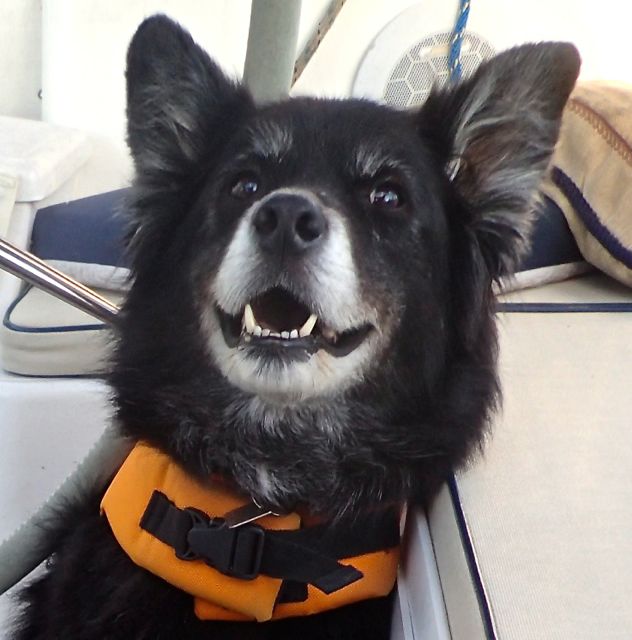
As is customary for Jax, he wore his life jacket throughout the ocean passage, although he showed very little interest in going up on deck to do his “business.”   When the seas roll, he prefers to stay low in the boat, close to our feet.  He is not interested in food or water.  We can only assume his tummy feels a bit “off”.  We gave him small ginger doggie treats to help with that at the outset.  
Utterly silent seas.

As the seas continued to flatten, Jax seemed to be more and more contented although until we shut off the engine and sat still in the water for a bit, he would not drink, nor empty his bladder.  Therefore, later in the afternoon, we picked a spot somewhere on the Little Bahama Bank and just sat in total silence for several minutes.  The quiet and calm was rejuvenating.  Meanwhile, Jax drank lots of water, made his rounds on deck and then we were off once again.  
Sunset behind us

Crossing the Banks the waters become nearly flat by the end of the day’s voyage and the winds all but nonexistent.   We followed our course as planned, which took us to the southwest side of a small inverted J shaped island, called Great Sale Cay (pro. “key) where we put down our anchor in 12’ of water.   Beyond us were the lights of 5 other sailboats and one trawler, similarly at rest on the water for the evening.  We were in the Bahamas at last.

The first of many stunning sunsets in the Bahamas.
*Jacklines—sturdy, non stretchy lines that are attached tightly on either side of the boat, extending from the stern to the bow.  When a sailor needs to go forward on deck, a tether is clipped onto the sailor’s harness (part of the inflatable life jacket) and also clipped onto the jackline.  In the unlikely event that the sailor gets tossed off the boat, the tether and jackline keep him attached to the boat.  


**Float Plan—a detailed plan about the intended destination and timeframe within which the boat is expected to arrive.  The plan is “filed” with someone on land who has an interest in knowing of our safe arrival.  In other words, it is NOT filled with the Coast Guard or any other formal entity, but rather a family member or close friend.  The plan also gives the recipient of the float plan detail about the boat and what they can do if they are concerned that the boat has not arrived as planned.

Friday, February 5, 2016

How is Our Galley Like Your Kitchen?

Spoiler Alert:  This is not an exciting topic--read at your own peril.
Upright edges or fiddles surround edges of counters

Twiddling my thumbs—waiting on a weather window to cross to the Bahamas in a week—maybe.  There are questions that pester some of our family and friends.  Q- “What do you do about food when you’re sailing?” (A- “We eat it, by mouth”).  Q- “How do you get groceries?”  (A- “We pay for them.”)  This topic deserves better explanations than those, so I’ve taken pictures to help explain how our galley is very much like your kitchen on land, and to allay any concerns about us eating a balanced diet aboard NORTHERN STAR. 
Open fridge.  Freezer is closed, on the left.

First of all, we have all the integral features of a regular kitchen:  refrigerator and freezer, stove with oven, and sinks with running water.   Our refrigerator and freezer, however, open from the top instead of the front.  They are two separate boxes, well insulated and with very heavy doors; if one of them fell on a head or hand, it would do major damage.  To prevent that from happening, we hook the door up with a chain while we dig around inside.  It’s a bit more difficult to get at all of the refrigerator’s contents than it is at your home (I’m making an assumption here) because it’s so deep.
Freezer space
On the plus side, it is quite large and can hold a lot of food.  We put foods on the bottom that we don’t use very much, or that are duplicates and store well, such as several pounds of butter and cheeses to last many weeks.  Also, a LOT of beer fits down there.  Because refrigerators operate more efficiently when they are full, we do our best to keep it that way.  The beer helps.  
Fridge set at 45 F and freezer at 5 F.  
We have something which you don’t have with your home fridge and freezer—digital gauges tell us what the internal temperature of each is at all times.  If we notice the temperature start to rise in either one, we know immediately and can take action to address the problem. 
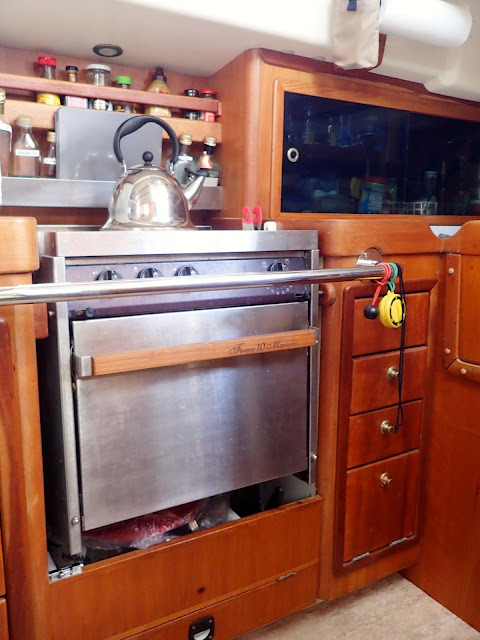
Storage below oven.  Stove balances on gimbals on either side of stove. 

Our stove runs on propane which I prefer over electric stoves on land or water.  It has one large burner and two smaller burners.  The oven is smaller than a home oven, so some of the baking dishes I used on land won’t fit in our oven.   The oven works well; it reaches the appropriate temperature and maintains it, but with one important caveat—if the burners are in use, the oven has to compete with them for the propane. 
Small metal box above serves as our toaster, used stovetop.
Consequently, we have to choose—stove top cooking?  Or oven?  We can’t do both at the same time.  We store a few metal baking pans inside the oven.  They don’t rattle around because the stove is gimbaled so it can swing freely when we’re under sail.  I have baked brownies and bread while sailing.  
Safety bar extends across stove.
Another feature that is absent on a home oven is a hip/waist high safety bar across the front of the stove to prevent the cook from falling into it as the boat moves. In fact, our boat came with a large “hip sling” that hooks onto the safety bar to prevent one from falling backwards while cooking as well. 
Purified water on left.  

We have two stainless steel sinks.  One of the faucets is purified water which we use for drinking only.  The other water tastes good, too and we use it for everything else onboard.  Although our boat can carry 140 gallons of water in two large tanks, we still try to conserve water as much as possible so we don’t have to fill up so often.  We have hot and cold water.  
Found great sprayer in gardening section.
We make hot water when the engine runs and when we’re plugged into electricity when we’re in a marina.  There are several ways to be water conscious.  We never fill the sink when it’s time to wash dishes.  Rather, we’ll half-fill the largest pan that we used for the meal and wash dishes in that.  Rather than rinsing soap off with the sprayer at the sink, we fill a 1/2 gallon pressurized spray bottle with hot water and rinse with that.  Works really well. 
Only essential utensils come onboard

Space conservation is essential.  Before anything is brought onto the boat, it is evaluated to ensure it is truly needed, and ideally, everything we have can serve more than one purpose.  Our pots and pans are a set of nesting cookware by Magma.  The handles and covers are interchangeable.  Although the pressure cooker doesn’t nest, it can hold a set of stainless steel bowls inside which come in handy when we’re prepping food for the pressure cooker. 
Getting canned goods out from under our bed is a two person job.
Several kitchen items are made of silicone which means they are 1) heat resistant, 2) don’t rattle and 3) they can bend to fit in tight spaces.  No space goes wasted.  That means that some of our food supplies are stored in places outside of the galley.  Even under our bed is a large space just the right size for canned goods.
Oddly shaped cupboard required creativity.
   Food storage is a bit different than on land.  Square containers are far more space efficient than round so that is what we use for the most part.  Cardboard does not belong on a boat.  For one thing, the paper becomes moist which isn’t good for the contents, secondly it apparently attracts bugs (which we thankfully have not experienced), and the packaging takes up space.  When we bring anything onto the boat, we first strip away all the cardboard and extraneous packaging.  Dry goods are put into air tight containers.  Square Lock ’n Lock
Lock 'n Lock and Hefty brand boxes with 4 latching sides.
containers work great for all cereals, rice, pasta, flour, cornmeal, crackers, nuts, etc.  We use small ones for things like table butter, brown sugar for our oatmeal—you get the idea.  Long term food containers should not have metal covers.  I had to get rid of some small spice bottles because they had metal covers that started to rust.  Table salt 

Cupboards above counter on either side of stove. 
really does not like living on a boat.  To have any chance that it will shake out, we have to keep grains of rice in the shaker to absorb moisture.  A salt grinder seems to work best.  Many foods do not have to be refrigerated which I did refrigerate living on land. 
Eggs stored safety on top of canned goods on starboard side.
Eggs, for example; just use them within a week or so.  Many condiments do not need to be refrigerated—ketchup, mustard, pickles, jams, relish, soy sauce, etc. and we keep a supply of cartons of milk that do not need refrigeration until they are opened.  The milk tastes great.  About glass bottles--if I am worried about a glass bottle breaking, I slip an old sock over it.  Stops any clinking anyhow.  
French drip method.  Coffee stays hot all day!
We do not carry some of the common household appliances.  We tend not to use things that have to be plugged in for cooking.  Some boaters do, but we plan to spend most of our time at anchor which means we won’t be plugged into 30 amp power.  Our solar panels provide enough power to keep the fridge, freezer and lights running, on sunny days.  We make coffee by pouring boiling water over grounds in a filter right into a wide mouth thermos.  Makes great coffee and it’s faster than a coffee maker.  We don’t have a toaster, but can make toast using one of those 
metal boxes that are used over a campfire.  Our propane grill is mounted on the stern which is really handy when we don’t want to heat up the boat.
Dinghy dock (crowded "parking")at Vero Beach, FL

How do we get groceries?  When we’re at anchor or marina, we walk or take a bus.  We have taken a taxi and rented a car a time or two for larger purchases.  We have a two wheel pull cart which we take along sometimes for heavy things.  Our garbage goes with us to shore, and groceries back from shore. 

Garbage tucked away below sink.

Our dinghy is our “car” on the water.  We have lots of sturdy, water resistant grocery bags, and some large dry bags, too, in case we have to transport in the rain. In short, we can do almost kind of cooking and enjoy nearly any food on the boat that you would have at home.  Bon appetit from NORTHERN STAR!