|
| Walking from the forest through dunes to shore |
On our journey south in December, we were in a bit of a hurry, and so we bypassed the Cumberland Island National Seashore, a huge oversight! I have visited lots of national parks and I have a long list of those that I hope yet to visit, but somehow this park had escaped my attention altogether before last fall coming down the ICW. For the most part, Cumberland National Seashore is a marvelous national park and I’ll elaborate on that “most part” later.
 |
| Northern Star is to the upper right part of photo. |
Cumberland Island is one of the barrier islands in Georgia, in fact the very last one before the Florida border. To get here, one must either ride on a park service ferry from the little town of St. Mary’s where the National Park Museum is located, or board a huge tourism boat from Fernandina Beach, FL, or come on one’s own boat and anchor in the river. We opted for the last means of transportation, naturally.
 |
| The decadence of one enormous live oak tree. It MUST be climbed! |
Campers may stay for up to one week on the island, in the midst of this live oak forest with palmetto forest floor. Beautiful! Many visitors come for the day, to walk the trails, beaches, salt marshes, or bicycle around the island. There are no paved roads and only park service vehicles.
 |
| Bikes helped us cover a lot of ground. |
The island’s history is long and rich. The first known residents, the heavily tattooed Timucuan Indians were introduced reluctantly to white man’s religion via a Spanish garrison and Jesuit mission built here in 1569 but it did not go over well with the natives and so the Spanish abandoned the effort only three years later. Later, Spain and England quarreled over ownership of the island for 100 years; there was a Spanish fort here and an English fort. Land was gifted as a reward to Revolutionary War heroes. Cotton plantations were built with slave labor (Eli Whitney promoted his cotton gin from here, unsuccessfully).
 |
| Spanish soldier's helmet |
In 1900, Thomas Carnegie, brother of Andrew, bought a huge portion of the island. On the island he built a family home which ultimately grew to be a 37,000 square foot house called Dungeness, complete with a large heated swimming pool, squash courts, steam room, a hunting lodge, and so on. A remarkable place.
 |
| Dungeness facing the water |
To provide services and food for the Carnegie family of 9 children and the steady stream of upper crust visitors and statesmen visiting here, a workforce of 300 black and white servants and skilled laborers was required, which brought an entire village into existence. Huge dormitories were built to house them. The village of course, was situated just out of sight of the main estate.
 |
| Dungeness facing the forest |
The Dungeness we see today, is a skeleton of the mansion which was destroyed by fire in 1978. Only a few of the 40 other buildings that once comprised the Dungeness estate still stand, but foundations of many more are there.
 |
| Tabby, uses shell, not gravel. |
Structures are often made of tabby, a combination of limestone, shells and concrete. I found the foundation of the Dungeness dairy which appeared to accommodate at least 28, maybe 32 milking cows. (Yes, I am a dairy farmer’s daughter). It is hard in these times to conceive of such wealth as is evident here. The Carnegies’ polo grounds and kenneled hunting dogs could only be fully appreciated with their many affluent friends staying with them for a week or two, thus, I suppose, the “need” for the 37,000 square foot house. (The upper crust folks probably don’t like to share bedrooms, even with other upper crust folks.)
 |
| Dungeness pergola. Beyond is the polo field. |
Fast forward to late 1900’s; a developer bought up much of the island with plans to build a “Hilton Head South.” The descendants of the Carnegies, in their own generous mansions scattered farther north on the island, got together to thwart that effort. They all donated their lands for a national park, and the Hilton Head concept was squelched. Thus, the entire island, save for a few palatial homes still occupied by the Carnegie descendants, is a national park with no town, and no services of any kind. It is once again, a mostly natural maritime forest.
 |
| Surprised to see how hairy he is underneath that shell. |
I met my first armadillo here. Quirky little fellows through no fault of their own. I would have loved to see one roll himself into a ball to see whether Jax would play with it. Wild hogs still occupy the island, and we did NOT see any of those, which was fine with me. There are six wild hog hunts each year to knock back the population explosion of pork on the hoof.
 |
| There are about 150 horses living on Cumberland Island |
And, there are wild horses. Unlike Assateague Island where the wild horse population is managed by rounding up a number of them each year to remove from the island, Cumberland Island NPS has to respect the intentions of the donors of the horses, the Carnegies, who simply turned them loose many, many years ago.
 |
| Note Whitey's ribs. |
Tourists enjoy seeing the horses. I admit, I enjoy seeing horses whenever I can as well. But these horses have been sharing the same gene pool for generations and a maritime forest floor is not an ideal place to find good foraging for a horse. Only 20% of the colts survive, the lone park service volunteer told us. The horses are indeed wild—and are treated as such. They do what they will on the island; horses rip the grasses off close to the ground (which certainly makes it appear as though the grounds around the buildings have been mowed) and make trails through the forest, dunes and salt marshes to get to what little fresh water is available.
 |
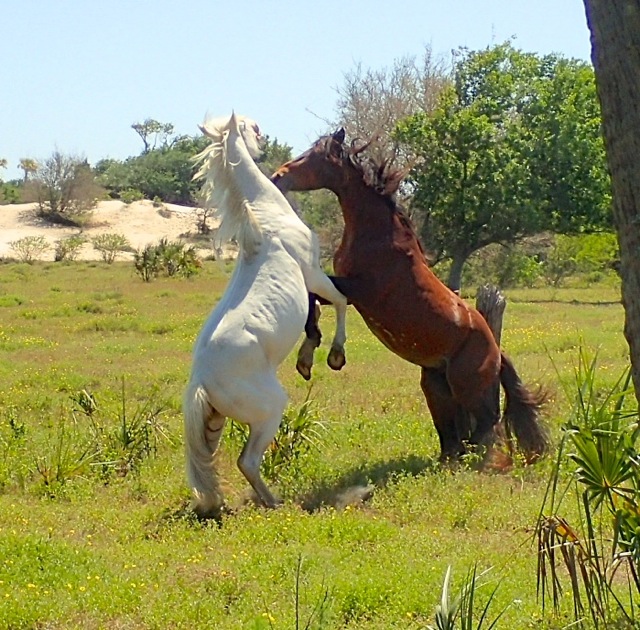
| Ill-tempered wild horses |
I am not an animal rights activist or anything nearly so strident as that, but I did have horses growing up and these horses do not look well to me. Their ribs are visible and their coats lack the lustre of good health. In short, I found myself sad to find that they are here, abandoned to fend for themselves in a fairly hostile (to horses) environment. Perhaps this environment lends itself to short-tempered horses, sharing a finite space with too many herbivores vying for the limited food. Maybe female horses get into “cat fights” just like junior high girls do, maybe they get kicked in the head too many times which has gotta raise the likelihood of horse concussion and consequently, poor horse judgment.
 |
| Truce? |
Whatever the reason, the two females that we witnessed fighting reminded me of an Animal Planet episode. And it did end with the white one getting a good strong kick to the head. We could hear the “chukunk” of the hoof making contact with the skull from 30 yards away. Whitey didn’t pester the brown horse after that. Probably still seeing stars.
 |
| Salt marshes. |
Yes, the horses are pretty (especially, from a distance, and I suppose if one doesn’t know what a healthy horse looks like) and it is novel and interesting to find them roaming wild here. But they don’t belong here. We (humans) domesticated them, and now I think we ought to care for them properly. A horse oughta have enough in his belly that he can afford to stand around lazily in the shade and swish the flies away on a hot day—not walk around hungry, constantly looking for that elusive bit of green food. And enough fresh water to drink, not salty brackish water. There, I said it.
 |
| Wherever grass grows, it has been overgrazed by the hungry horses. |
If the horses were gone, or at least the population significantly diminished, the Cumberland Island National Seashore would be an even more marvelous natural maritime forest for us all to enjoy.